Opendoor is the largest iBuyer in the US - a tech
company that buys homes directly from sellers for cash (close in 14 days) and resells
them. Think "CarMax for homes."
The transformation: New CEO Kaz Nejatian
(ex-Shopify COO, $1 salary) is "refounding" Opendoor as an AI-first software company.
Doubled acquisition speed in 7 weeks. Targeting profitability by end of 2026.
The opportunity: $2T residential real estate
market, ~1% iBuyer penetration. If Opendoor captures 3-5% with sustainable margins, it's
a $50B+ company.
A new dawn for real estate: Opendoor's mission to
simplify home selling
What is Opendoor?
Opendoor is the
largest "iBuyer" in the United States - a technology company that buys
homes directly from sellers with a cash offer, then resells them on the open market.
Think of it as "CarMax for homes." Instead
of listing your home, hosting showings, negotiating with buyers, and waiting months for
a sale - you can get a cash offer in 24 hours and close in as few as 14 days.
The trade-off: You typically get ~5-7% less
than market value. But for many sellers, the certainty, speed, and convenience are worth
the cost.
Why Does Opendoor Exist?
Selling a home is one of the most stressful, time-consuming transactions most people ever
experience:
The Traditional Process
3-4 months average time to sell
Dozens of showings with strangers
Repairs, staging, open houses
Uncertainty until closing day
Coordinating with agent, buyer, lender
The Opendoor Process
Cash offer in 24 hours
Zero showings required
Opendoor handles all repairs
Guaranteed closing date you choose
One company handles everything
Who Should Know About Opendoor?
This guide is essential for:
New employees joining Opendoor who need to understand the business
Investors evaluating OPEN stock and the iBuyer market
Real estate professionals understanding the competitive landscape
Tech industry observers following the Kaz Nejatian AI transformation
Anyone curious about how technology is reshaping real estate
Key Terms Glossary
iBuyer — "Instant Buyer." Company that uses technology to make
instant cash offers on homes.
Contribution Margin — Revenue minus direct costs per home.
Opendoor targets 5%+ for sustainability.
Spread — Difference between buy price and sell price. Opendoor's
profit after costs.
Service Fee — Opendoor's fee to sellers (typically 5%). Covers
pricing risk and convenience.
Eric Wu founded Opendoor in 2014 after experiencing the pain of selling his own home. His
insight: the traditional home selling process hadn't been meaningfully improved in decades,
despite technology transforming nearly every other major transaction in our lives.
"The median homeowner spends 3-4 months selling their home. What if we
could make it as simple as selling your car to CarMax?"
Eric Wu, Founder & Former CEO
Key Milestones
2014
Founded in San Francisco. First market: Phoenix, AZ -
chosen for its large, homogeneous housing stock and predictable appreciation
patterns.
2015
Y Combinator (W15). Raised $9.95M seed round from Khosla
Ventures. Purchased first 35 homes.
2016-2018
Rapid expansion to 18 markets. Raised $325M Series D at
$2B valuation. SoftBank Vision Fund invests $400M.
2020
Goes public via SPAC merger with Social Capital Hedosophia
II. Valued at $4.8B. COVID briefly pauses operations.
Interest rates spike. Q3 losses of ~$1B. December: Eric Wu
steps down as CEO, CFO Carrie Wheeler takes over. 18% layoffs.
2023
Continued inventory challenges. Additional layoffs (35%
total workforce reduction). Stock falls 90%+ from peak. Eric Wu leaves company
entirely in late 2023.
2024
Under CEO Carrie Wheeler, continued turnaround efforts.
Housing market remains challenged with high rates. Progress toward profitability but
still posting losses.
2025
August: Carrie Wheeler steps down as CEO. September: Kaz
Nejatian (ex-Shopify COO) appointed CEO. Keith Rabois becomes Chairman, Eric Wu
rejoins board. Q2 2025: First adjusted EBITDA profitable quarter since 2022 (+$23M).
The Founding Team
Eric Wu (Co-Founder, CEO 2014-2022) - Serial entrepreneur. Previously
founded Movity (acquired by Trulia). Stanford engineering dropout. Stepped down as CEO
in December 2022, left company in late 2023, returned to board in September 2025.
Keith Rabois (Board, Early Investor) - PayPal Mafia member. Khosla
Ventures partner. Instrumental in early strategy and fundraising.
Ian Wong (Co-founder, CTO 2014-2020) - Former
Square data science lead. Built the pricing algorithms that power Opendoor's offers.
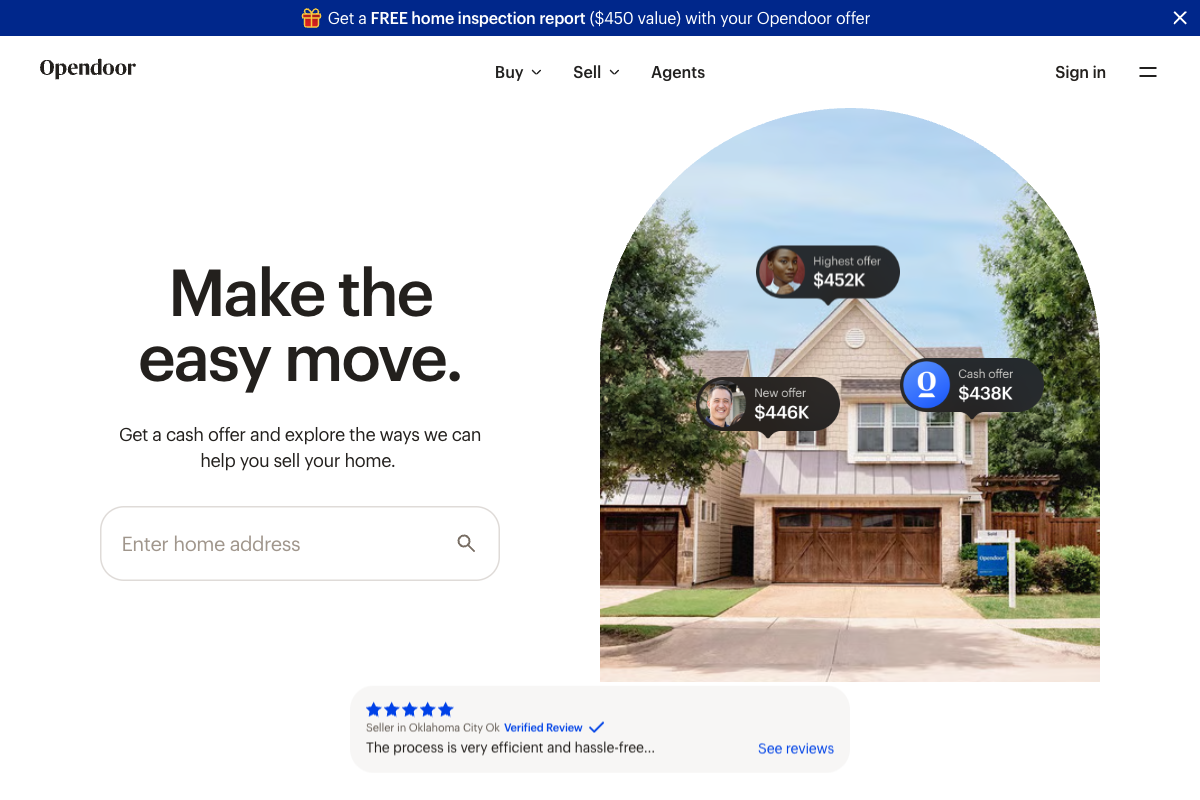
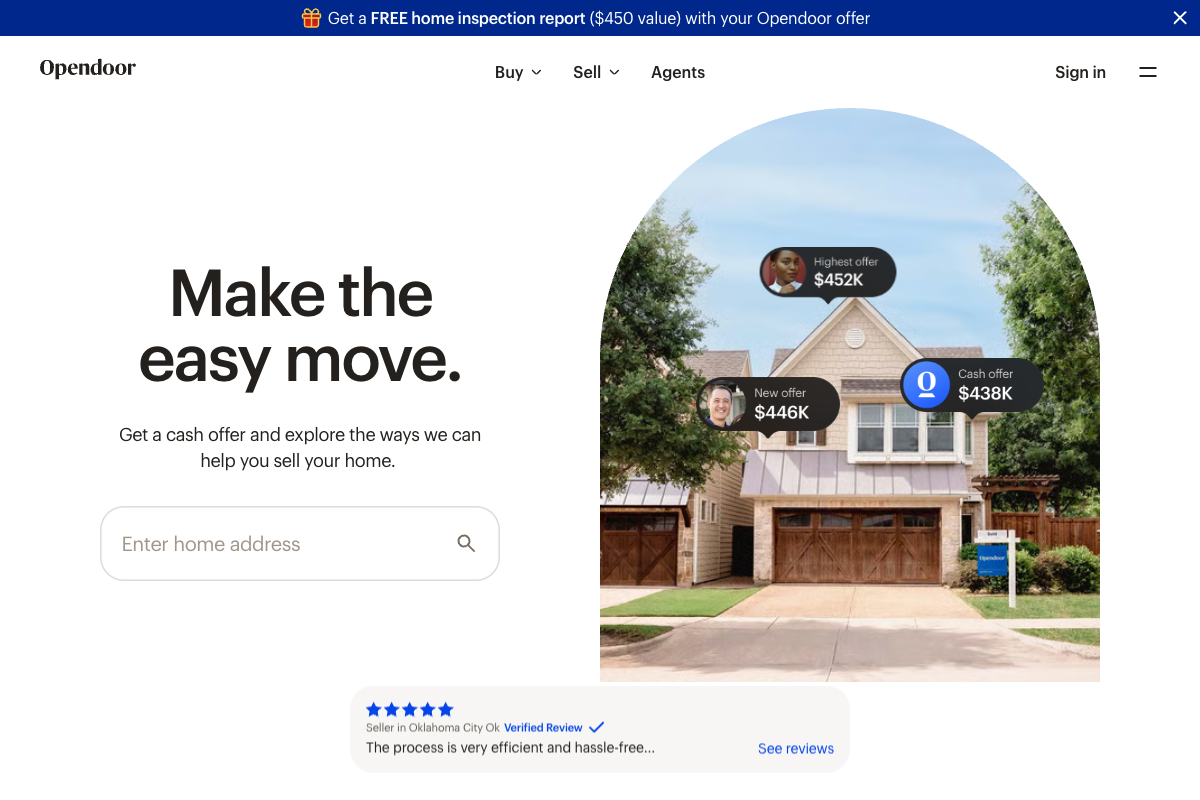
Opendoor's current homepage - "Make the easy move"
Opendoor's core value proposition is simple: sell your home with certainty.
No showings, no repairs, no waiting. It's the "CarMax for homes" model.
The Selling Journey
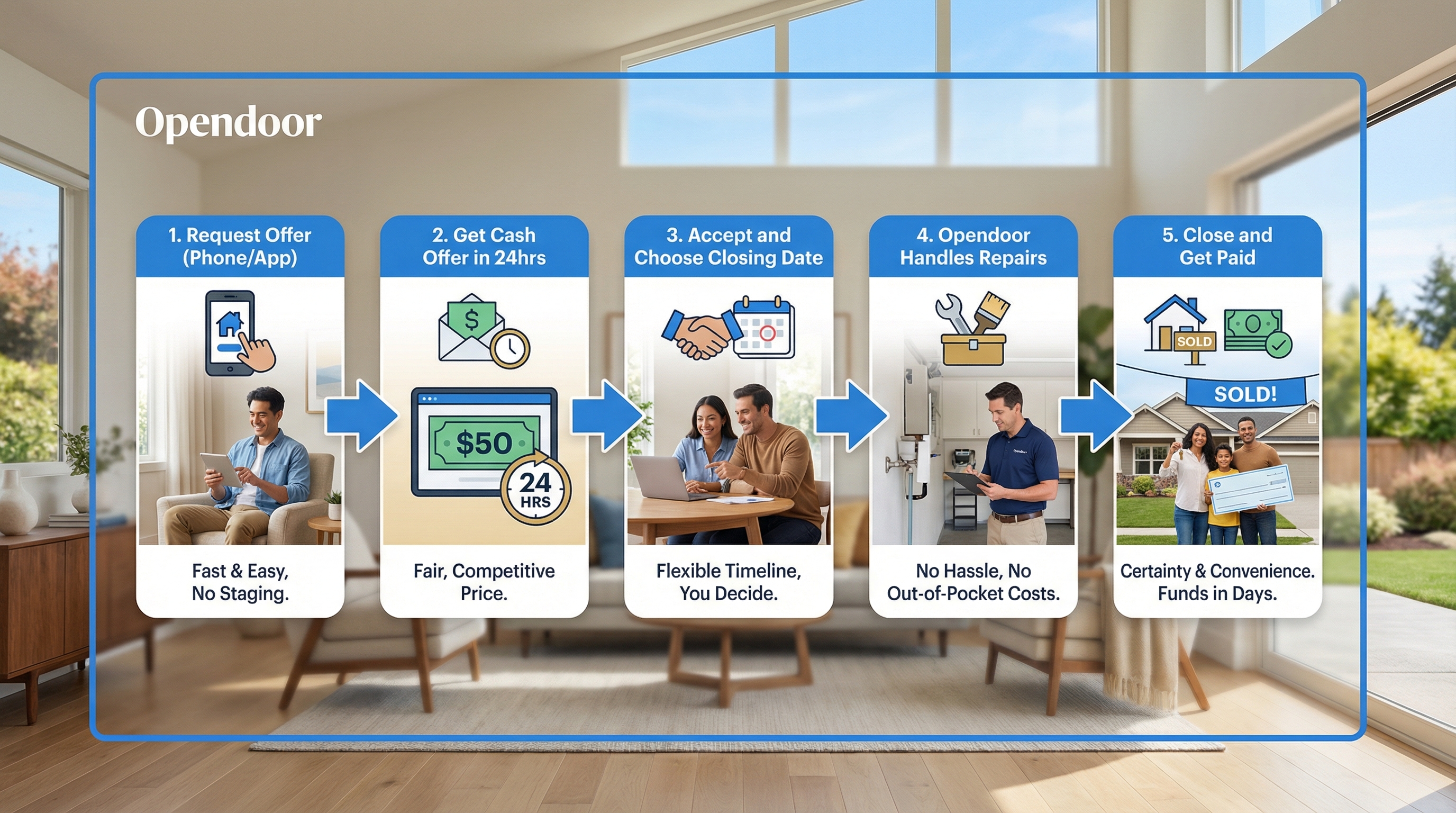
Here's how selling to Opendoor works - from request to close in as few as 14 days:
The 5-step selling journey: Request → Offer → Accept →
Repairs → Close
Two Ways to Sell
Sell to Opendoor
Skip the stress of showings and open houses. Pack on
your schedule.
Sell with a preferred agent
List on the market with Opendoor as your backup offer.
Who Uses Opendoor?
Understanding Opendoor starts with understanding who needs this service. It's not
about maximizing sale price - it's about solving real life problems.
The Relocator
Got a job offer in another city. Needs to move in 3 weeks. Can't wait 90 days for a
traditional sale.
Life Transitions
Divorce. Inheritance. Health issues. Sometimes you need out fast, not maximum profit.
The Privacy-Seeker
Doesn't want strangers walking through their home. No open houses. No showing
schedules.
The Busy Professional
Values time over money. Would rather pay 5% than spend 40 hours on showings and
negotiations.
A Seller's Story
Seller Story
Sarah Chen
Phoenix, AZ → Seattle, WA | Job Relocation
Sarah got the call on a Tuesday: her company was promoting her to lead the
Seattle office. Start date: three weeks out.
Her Phoenix home was worth around $420,000. A traditional agent told her it would
take 45-60 days to sell, plus 30 days to close. That's 3 months minimum - she
had 3 weeks.
She could rent it out, but she didn't want to be a long-distance landlord. She
could leave it empty and sell later, but that meant paying two mortgages.
Neither option worked.
Then she found Opendoor. She entered her address at 9pm. By noon the next day,
she had a cash offer for $398,000. Lower than market? Yes. But it solved her
actual problem.
Sarah closed in 14 days, moved to
Seattle, and started her new job on time. She paid ~5% less than market value
but avoided 3 months of stress and carrying costs.
Sarah's Journey with Opendoor
Day 1 - Tuesday Evening
The Panic & The Search
Sarah gets the promotion call. Excitement turns to stress when
she realizes she has to sell her house in 3 weeks. She Googles "sell house fast
Phoenix" at 9pm and finds Opendoor.
Feeling: Anxious, overwhelmed
Day 1 - 9:15pm
Enter Address & Answer Questions
10 minutes filling out basic info about her home - beds,
baths, upgrades, condition. Uploads a few photos from her phone. No commitment yet.
Feeling: Cautiously hopeful
Day 2 - 11:47am
Preliminary Offer: $405,000
Opendoor's algorithm analyzes comparable sales, market trends,
and her home details. She receives an initial cash offer via email and text. It's
real - not a bait number.
Feeling: Surprised, relieved
Day 4
Home Assessment
An Opendoor rep walks through for 30 minutes. They note the
HVAC is original (2008) and the carpet needs replacing. These become repair credits.
Feeling: Nervous about adjustments
Day 5
Final Offer: $398,000
$7,000 deducted for HVAC and carpet. Sarah accepts. She picks
a closing date 14 days out - the day before her flight to Seattle.
Feeling: Decisive, in control
Day 19
Closing Day
Sarah signs digitally. $398,000 minus the 5% service fee
($19,900) and standard closing costs (~$4,000) hits her account. Net: $374,100.
Feeling: Free, ready for Seattle
The math: Sarah netted ~$374K in 19 days. A
traditional sale might have netted ~$395K... in 90+ days. For Sarah, the $21K difference
bought certainty, speed, and peace of mind during a major life transition.
Real Customer Voice
"I chose to go with Opendoor because of the convenience of selling my
home without having open houses, and showings. I have a child on the Autism Spectrum who
has extreme difficulty with change and wouldn't be able to handle people going in and
out of our home. Working with Opendoor was very easy, fast, and professional."
Verified Opendoor Seller, 2025
The Opendoor seller experience starts with a single address
entry
The Traditional Pain Points
95% of sellers find the process stressful. The
biggest pain? Uncertainty - 56% say not knowing if their home will sell in time is the
most stressful part. (Zillow Research)
Time: Conventional process stretches 3-6 months
Showings: Keeping a home "show-ready" while living in it
Staging: $2,000-$7,200 for a 2,000 sq ft home
Uncertainty: Deals fall through, financing fails, timelines slip
Coordination: Aligning sell date with new purchase
The Opendoor Process
1
Enter Address
~10 minutes to complete
2
Get Offer
Within days
3
Assessment
30-min walkthrough
4
Pick Close Date
14-60 days out
5
Get Paid
Cash at close
Selling Options
1. Sell to Opendoor (Cash Offer)
The original iBuyer model. Sell directly to Opendoor for cash. 5% service fee (comparable
to agent commissions).
2. Cash Plus (New 2025)
Get a cash advance upfront, then list on the open market. If it sells for more, you share
the upside.
3. List with Partner Agent
Work with an Opendoor-vetted agent while keeping your cash offer
as backup.
The Tradeoffs
Opendoor typically pays 91-95% of market value. The
tradeoff is speed, certainty, and convenience - not maximum price.
Section 3
How Buying Works
Self-service home buying and Opendoor Exclusives
Opendoor isn't just for sellers. The company has built a buyer experience around
convenience and self-service - particularly powerful after the August 2024
NAR settlement.
The Buying Journey
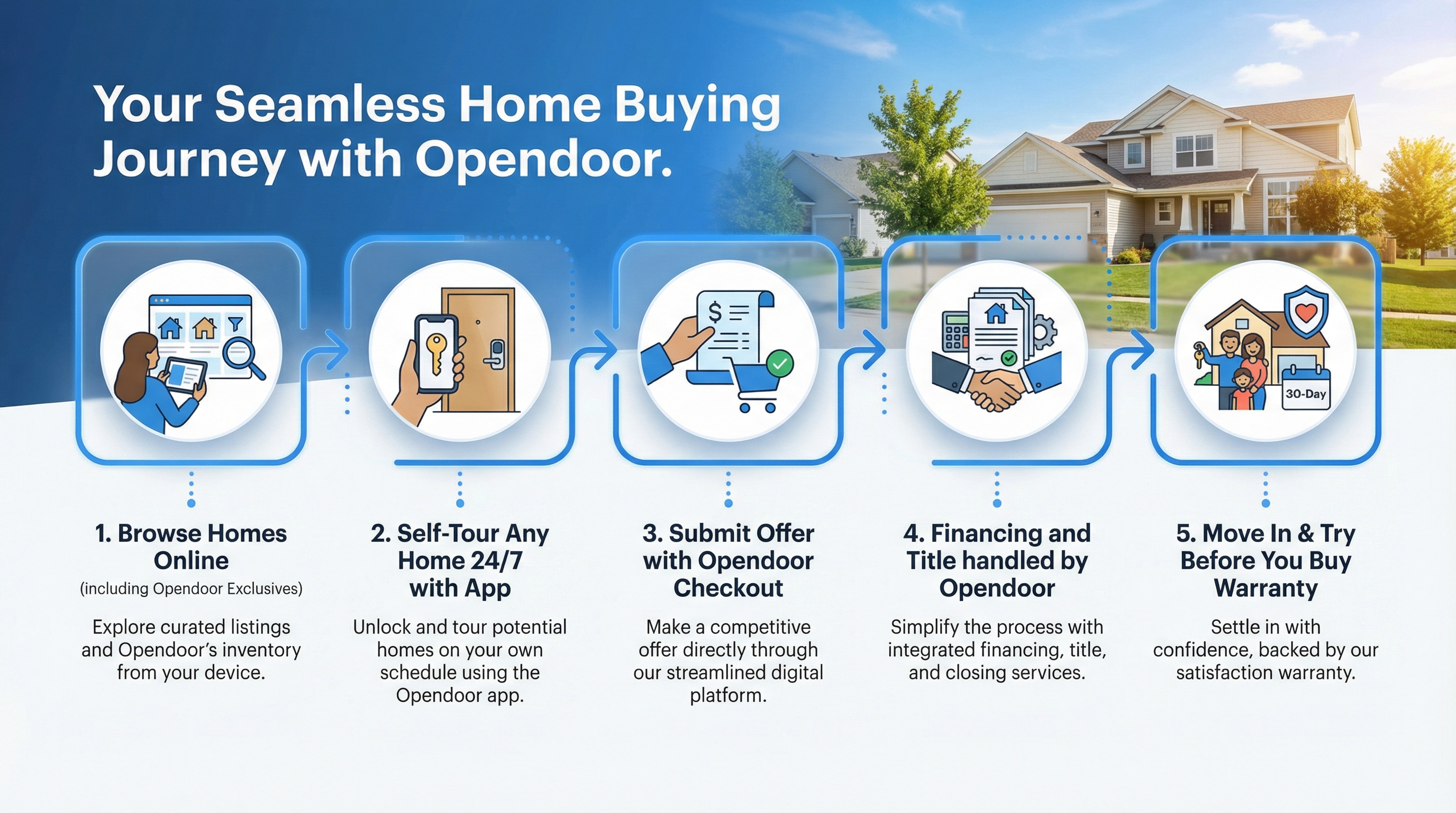
Here's how buying with Opendoor works - a self-service experience from browsing to move-in:
The 5-step buying journey: Browse → Tour → Offer →
Close → Move In
The magic of discovery: Walking through a sun-filled home
and imagining your future
A Buyer's Story
Buyer Story
Marcus & Elena Rodriguez
Dallas, TX | First-Time Buyers, Dual Income
Marcus works nights as an ER nurse. Elena is a software engineer with
back-to-back Zoom calls from 9am-6pm. Finding time to tour homes together?
Nearly impossible.
Their real estate agent was great, but coordinating schedules meant
maybe one showing per week. At that pace, homes they liked were under
contract before they could see them.
Then Elena found Opendoor Exclusives. Houses they could tour themselves,
at 7pm after her calls or 8am before Marcus slept. No agent coordination. Just
unlock with the app and walk through.
They toured 11 homes in one weekend. On Sunday night, they found it: a 3-bed in
Frisco, listed as an Exclusive at $385,000 - $12K below what similar homes were
fetching on Zillow.
Closed in 21 days with Opendoor's
cash offer backing their financing. No bidding war. No competition. They moved
in 6 weeks after first downloading the app.
The Self-Tour Experience
Saturday 7:30am
Browse & Book
Elena scrolls Opendoor Exclusives over coffee. Finds 4 homes
in their budget within 20 minutes of Marcus's hospital. Books self-tours for when he
wakes up.
Feeling: Excited, in control
Saturday 2pm
Self-Tour #1
They pull up, open the Opendoor app, and tap "Unlock." The
smart lock clicks. They walk through alone, FaceTiming Elena's mom for her opinion.
No agent hovering.
Feeling: This is weird... but awesome
Saturday - Sunday
Tour 11 Homes
Between Marcus's naps and Elena's coding breaks, they tour
every Exclusive in their target area. They'd never have done this with a traditional
agent.
Feeling: Efficient, thorough
Sunday Night
The One
The Frisco house checks every box. Listed at $385K as an
Exclusive. Similar homes on MLS: $397K+. They tap "Reserve" in the app and sign a
contract by 10pm.
Feeling: We found it. This is home.
Day 21
Keys in Hand
Financing clears. Opendoor's appraisal guarantee meant no
last-minute surprises. Marcus and Elena get the keys on a Tuesday morning.
Feeling: Homeowners.
Why Opendoor Exclusives matter: Opendoor owns
~4,500 homes at any given time. Buyers get early access, off-market pricing, and the
freedom to tour on their own schedule. No bidding wars. No contingency races.
Opendoor Exclusives
Opendoor owns significant inventory across 50+ markets. These are "Opendoor Exclusives" -
homes you can tour, buy, and close on without the traditional MLS process.
Opendoor Exclusives: Off-market inventory only available
through Opendoor
Off-Market Access
Homes not on Zillow or Redfin. First-mover advantage.
Self-Touring
Unlock with your phone. Tour on your schedule. No agent
needed.
Skip Bidding Wars
Buy at listed prices directly from Opendoor.
Price Protection
If appraisal comes in low, Opendoor adjusts the price.
Self-Tour Technology
This is particularly relevant post-NAR settlement (August 2024), when new rules required
buyers to sign agreements before touring homes with agents.
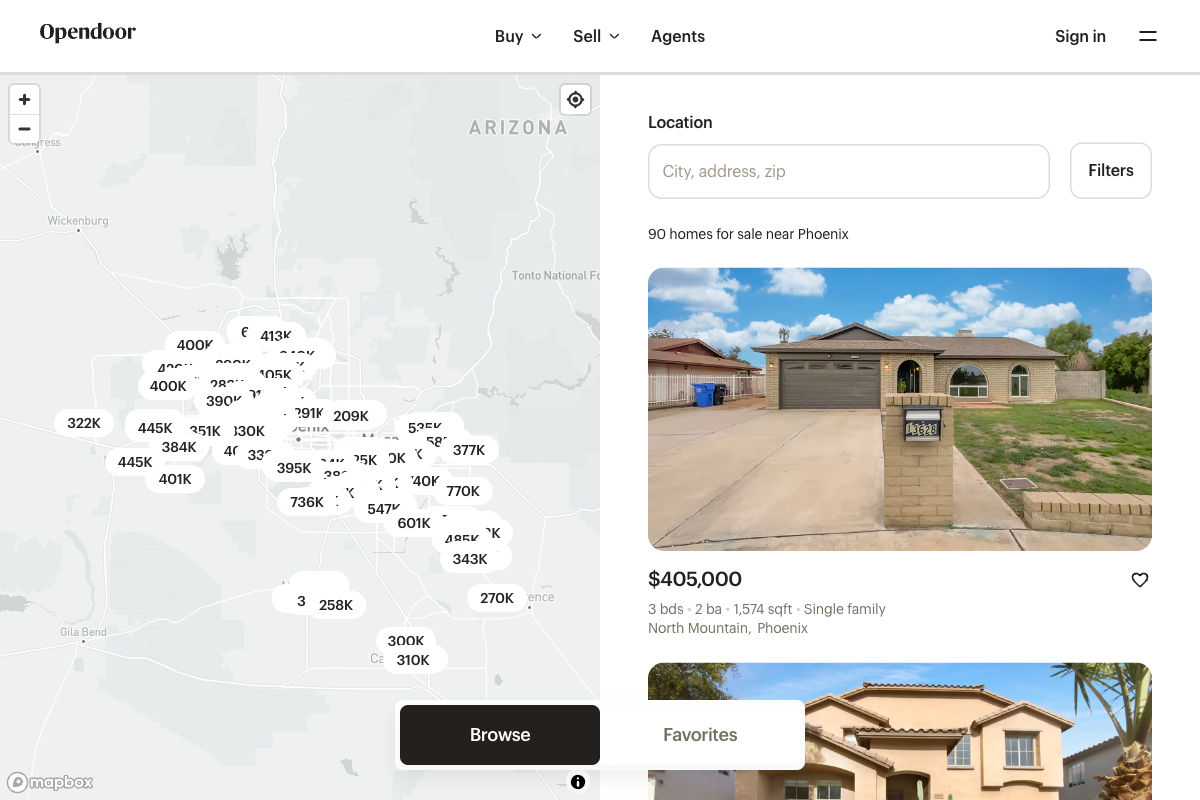
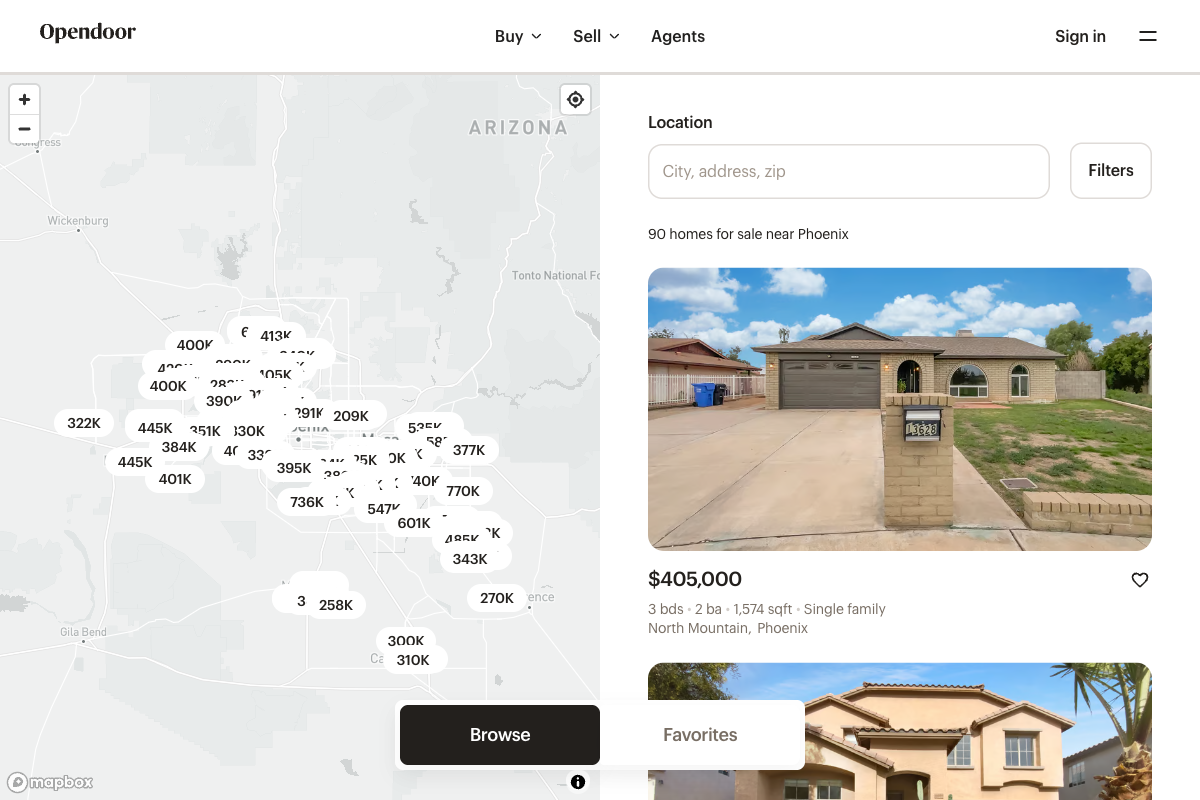
Opendoor homes in Phoenix - one of their largest markets
Try Before You Buy: In select markets (Dallas
pilot), buyers can move in and live in a home before committing to purchase.
Section 4
The Business Model
How Opendoor makes money
The Business Flywheel
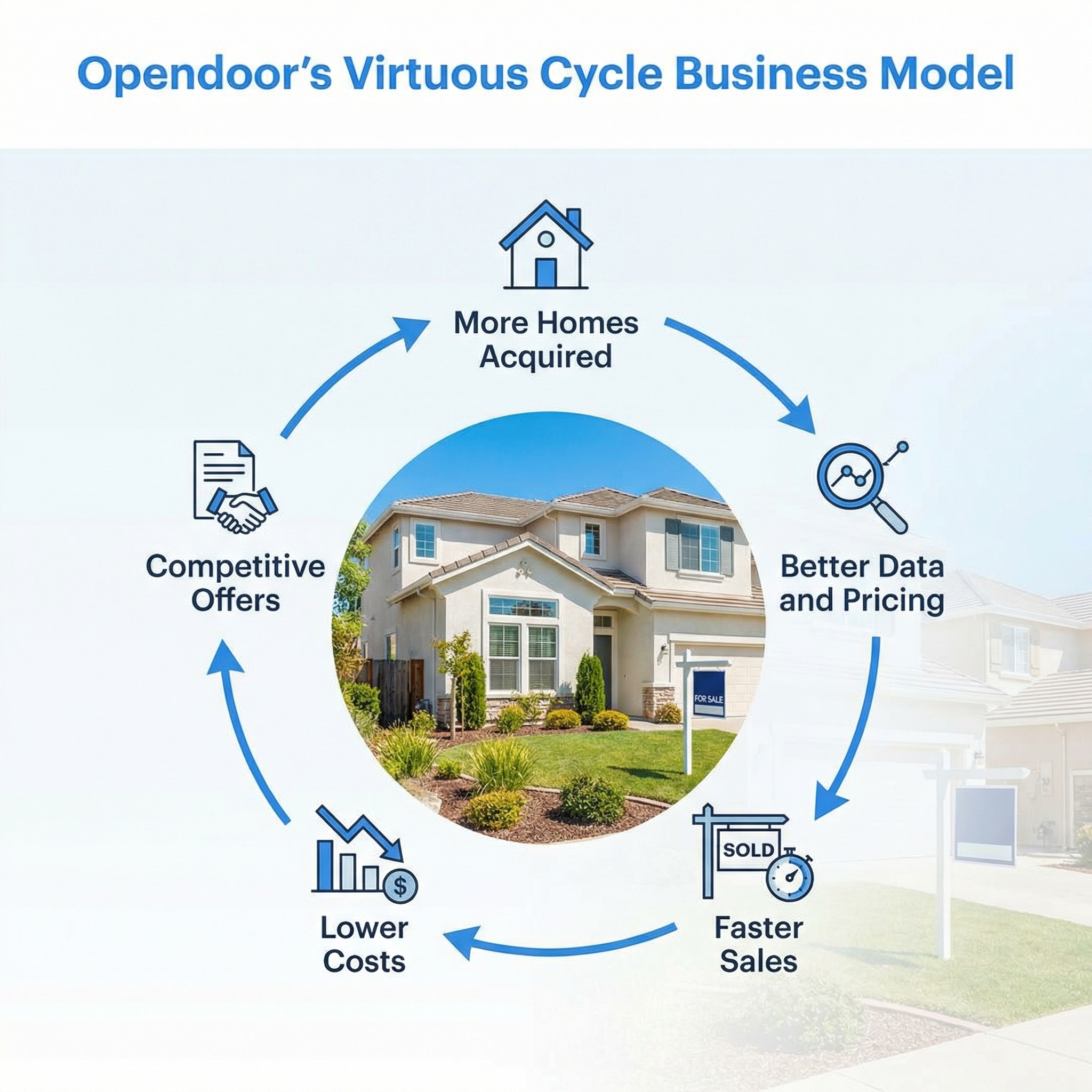
Opendoor's business model creates a powerful virtuous cycle - more volume drives better data,
which enables better pricing, which attracts more sellers:
The flywheel: Volume → Data → Pricing → Competitive
Offers → Volume
Core Revenue: Buy-Renovate-Sell
Opendoor's primary business is straightforward: buy homes, make light repairs, and resell on
the open market.
The Unit Economics
Service Fee: ~5% of purchase price (down from 6% historically)
Spread: Difference between buy and sell price (typically 3-7%)
Renovation Profit: Light repairs increase value by more than cost
Target Contribution Margin: 5-7% per home
Q2 2025 Revenue
$1.6B
+36% QoQ
Homes Sold (Q2)
4,299
+5% YoY
Contribution Margin
4.4%
Per Q2 2025
Gross Margin
8.2%
$128M gross profit
Why It's Hard
Capital intensity + low margins + price volatility = high
difficulty. You need billions in inventory, but prices can shift faster
than you can resell.
The Capital Stack
Opendoor uses a mix of equity and debt to finance inventory:
Asset-Backed Credit Facilities: $7.3B in capacity
Non-Recourse: If a home loses value, lenders can't come after
Opendoor's other assets
Spread Business: Borrow at ~7%, sell at ~10% spread = margin capture
Expanding Revenue Streams
Adjacent Services: Title insurance, escrow, mortgage (via partnerships).
These add margin without inventory risk.
List with Opendoor: Earn referral fees when
sellers choose traditional agents instead of cash offers.
Section 5
Market Opportunity
The $2 trillion residential real estate market
The scale of opportunity: Millions of American homes
change hands every year
US Home Sales (2024)
$2T+
~4M transactions
iBuyer Market Share
~1%
Down from 1.3% peak
Opendoor TAM
$1.4T
In serviceable markets
Current Penetration
0.4%
Massive runway
The Structural Opportunity
Real estate has been stubbornly resistant to digital transformation. Why? High prices,
emotional stakes, and entrenched intermediaries.
"Residential real estate is still a $100B/year commission business
where 89% of sellers use a traditional agent. That's not innovation-proof - that's
innovation-ready."
The National Association of Realtors settled a landmark antitrust lawsuit for
$418M. New rules effective August 17, 2024 ended the practice of sellers
automatically paying buyer agent commissions. Buyers must now sign agreements
before touring homes. This disruption opens doors for alternative models like
Opendoor's self-touring and direct buying.
Consumer Expectations — Millennials/Gen Z expect Amazon-like
experiences
Younger buyers grew up with one-click purchases and same-day delivery. They
expect transparency, speed, and digital-first experiences. Traditional 3-6 month
home sales with multiple agents feel antiquated to this demographic, which now
represents the largest share of homebuyers.
Labor Market Fluidity — Remote work = more relocation = more
transactions
Post-COVID remote work policies have untethered workers from office locations.
This has driven migration to lower-cost Sunbelt markets (where Opendoor is
strongest) and increased overall household mobility, generating more real estate
transactions.
Aging Population — Boomers downsizing creates selling demand
Baby Boomers own ~44% of US homes. As they age and downsize, they prioritize
convenience over maximizing sale price - exactly Opendoor's value proposition.
This demographic shift could unlock significant inventory over the next decade.
Mortgage rates rose from ~3% in 2021 to 7%+ in 2024. Higher rates reduce
affordability, decrease transaction volumes, and can pressure home prices.
Opendoor's financing costs also rise with rates, squeezing margins on both ends.
Housing Affordability — Median home price vs income at
historic highs
The median US home price (~$420K) relative to median household income (~$75K) is
at or near all-time highs. This affordability crisis suppresses first-time buyer
demand and overall transaction volumes, limiting Opendoor's addressable market.
Inventory Shortage — "Golden handcuffs" keep owners locked in
~60% of mortgages have rates below 4%. Homeowners are reluctant to sell and give
up these low rates for a new 7% mortgage. This "lock-in effect" has reduced
existing home sales to 30-year lows, constraining the entire market.
Regional Concentration — Sunbelt focus is both advantage and
risk
Opendoor is heavily concentrated in Sunbelt markets (Phoenix, Dallas, Atlanta,
etc.) where housing stock is more homogeneous and predictable. While this aids
their pricing algorithm, it also exposes them to regional downturns - as seen in
2022 when these markets corrected sharply.
Section 6
Competitive Landscape
iBuyers, portals, and the real estate ecosystem
The Real Estate Ecosystem: Key Players
To understand Opendoor's position, you need to understand the complex web of organizations,
regulations, and players that make up the $2 trillion residential real estate market.
NAR (National Association of Realtors)
The powerful trade association with 1.5M+ members that has
shaped real estate for decades. Controls the trademark "Realtor" and historically
enforced the 5-6% commission model through MLS rules.
August 2024
Settlement: NAR agreed to pay $418M and eliminate rules requiring sellers
to pay buyer agent commissions. This is the biggest change to real estate in 50 years -
and creates opportunity for Opendoor.
MLS (Multiple Listing Service)
The database where homes are listed for sale. Historically
controlled by local Realtor associations with restrictive rules. Zillow, Redfin, and
others syndicate MLS data - but Opendoor's Exclusives program bypasses
MLS entirely, listing homes only on Opendoor.com for 14 days first.
Traditional Brokerages
Keller Williams, RE/MAX, Coldwell Banker, Century
21 - The franchise models that dominate residential real estate. Agents are
independent contractors, not employees.
Opendoor isn't trying to replace
agents - they partner with them through the Opendoor Exclusives program and agent
referral network.
Title & Escrow Companies
First American, Fidelity National, Old
Republic - Handle the closing process, title insurance, and escrow.
Opendoor uses these partners but is building more of the closing stack in-house.
Mortgage Lenders
Rocket Mortgage, United Wholesale Mortgage, Wells Fargo
Home Lending - Finance home purchases. Opendoor partners with lenders but
interest rates directly impact their business (higher rates = fewer buyers = longer
holding periods).
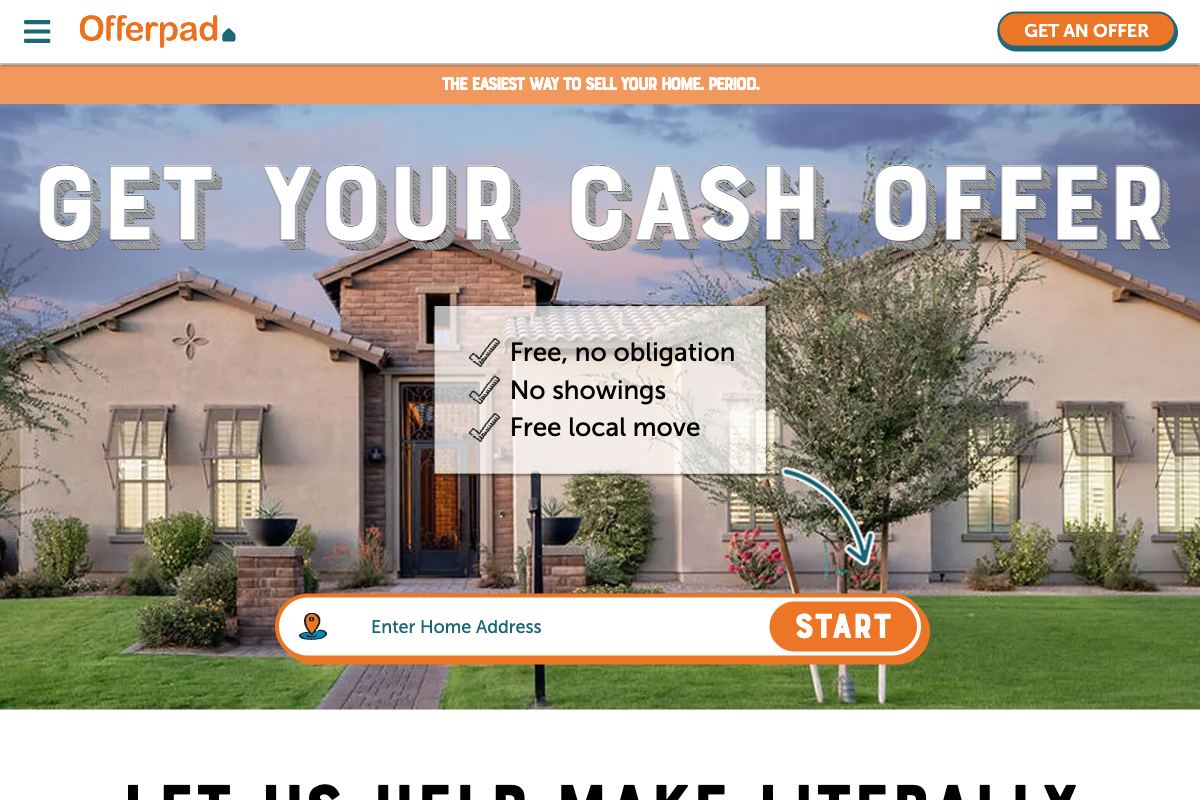
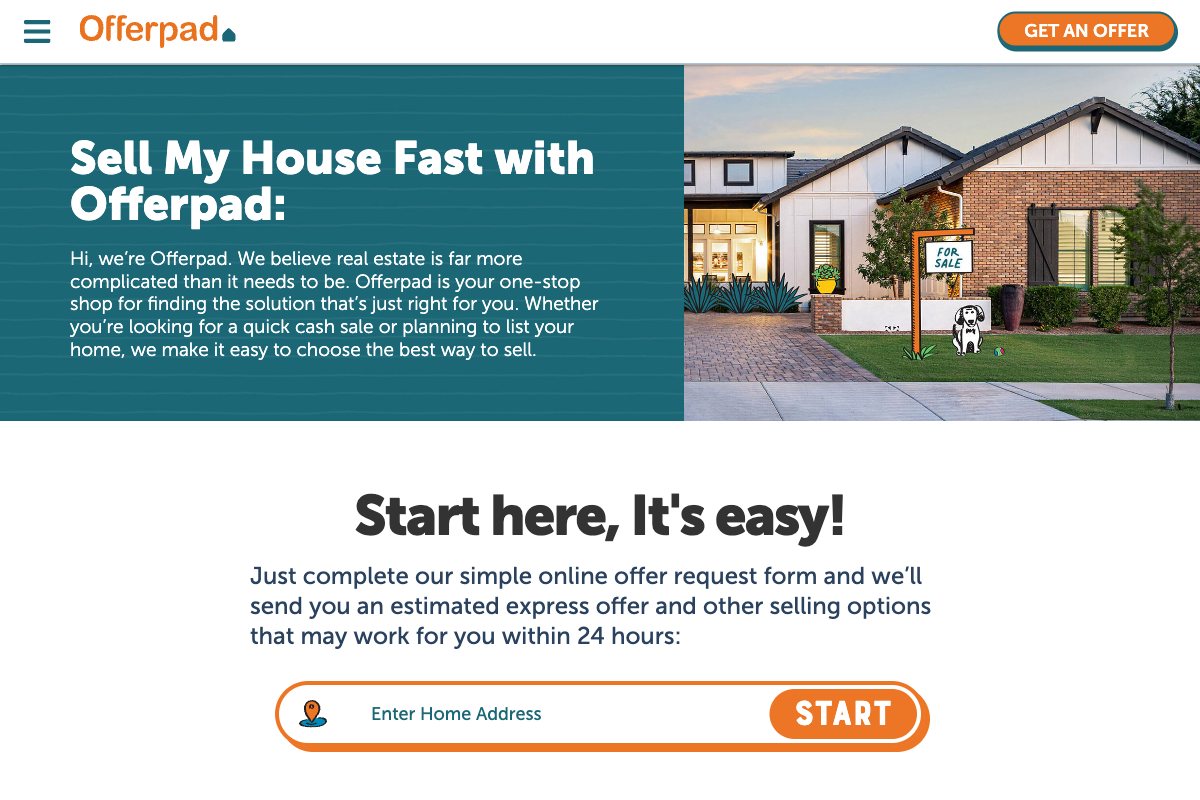
Offerpad - Direct iBuyer Rival
Opendoor's most direct competitor. Similar model, smaller scale, more conservative approach.
2024 Revenue: $919M (down 30% YoY)
Strategy: Capital-efficient, regional focus
Differentiator: Free local move, B2B renovation services
Challenges: Stock down 30% in 2025, struggling with scale
Offerpad: Direct iBuyer competitor
Similar process to Opendoor
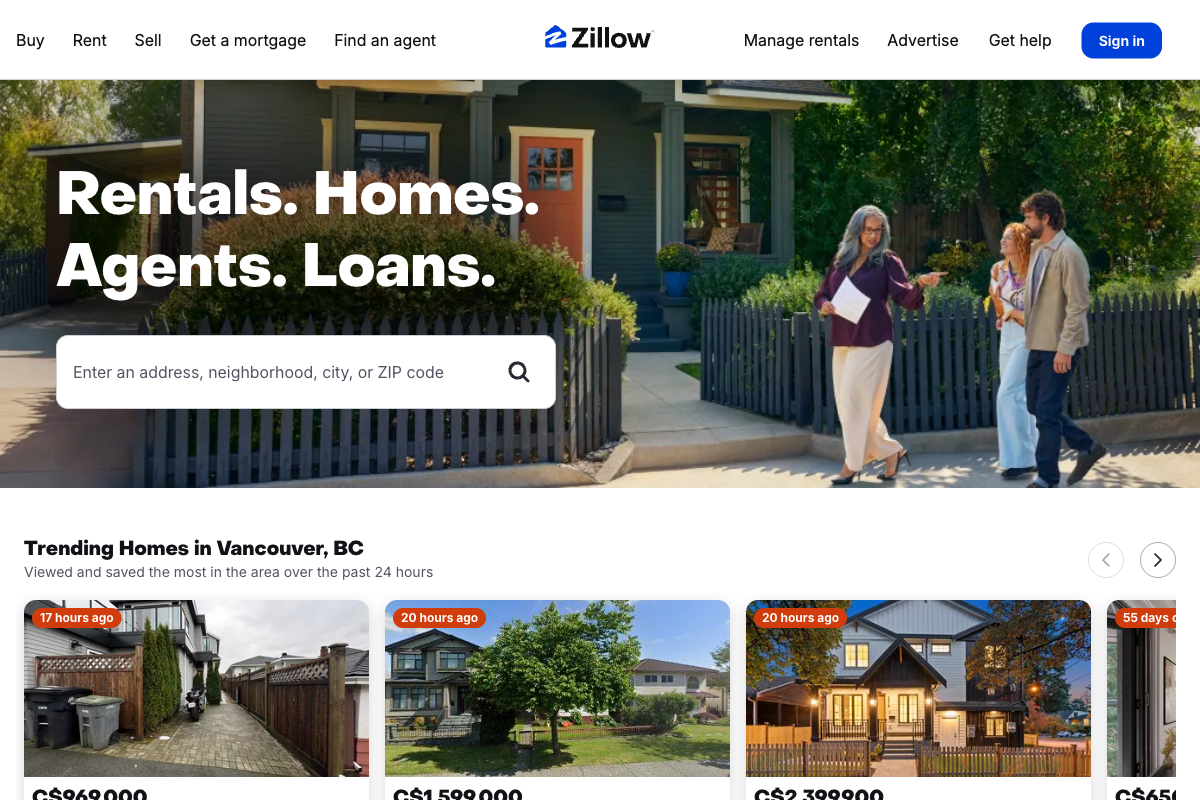
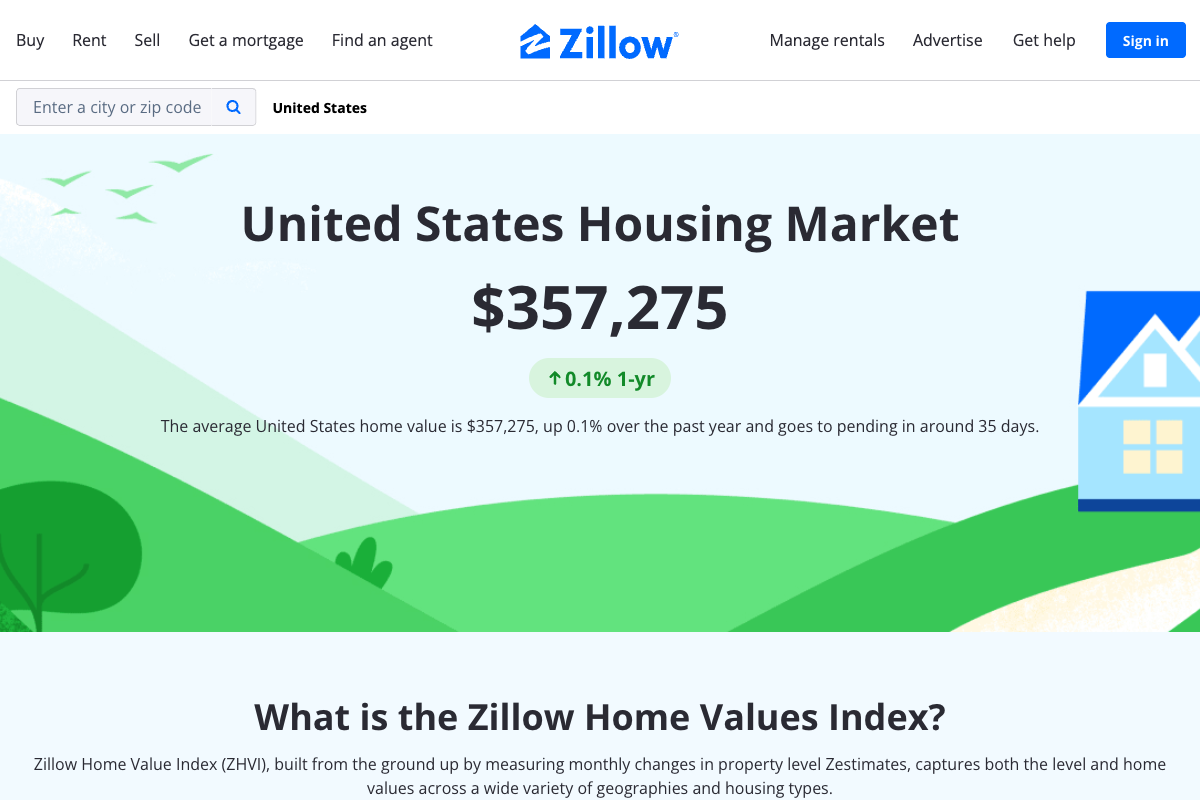
Zillow - The Cautionary Tale
Zillow launched Zillow Offers in 2018, scaled aggressively, then spectacularly imploded in
November 2021.
"We've determined the unpredictability in forecasting home prices far
exceeds what we anticipated."
Rich Barton, Zillow CEO (November 2021)
What went wrong: "Project Ketchup" used Zestimate
as offer price, algorithm couldn't adapt to market shifts, $500M+ loss in Q3 2021 alone.
2,000 layoffs. Opendoor surviving this period was no small feat.
Zillow: Exited iBuying in 2021
Zestimate: The algorithm that failed
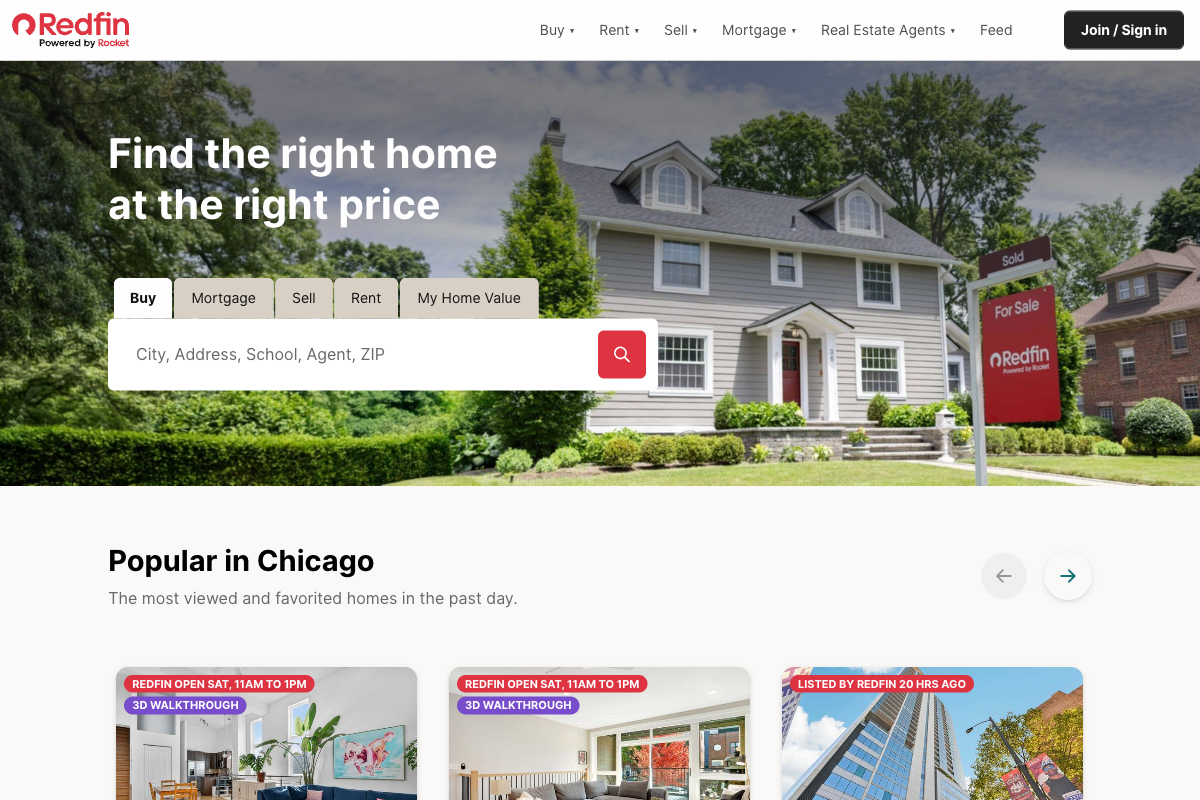
Redfin + Rocket - The New Threat
In 2025, Rocket Companies acquired Redfin for $1.75B, creating a vertically integrated
homebuying stack.
Redfin: Search, agents, listings
Rocket Mortgage: Largest mortgage lender in America
Rocket Homes: Closing services
Redfin: Now "Powered by Rocket"
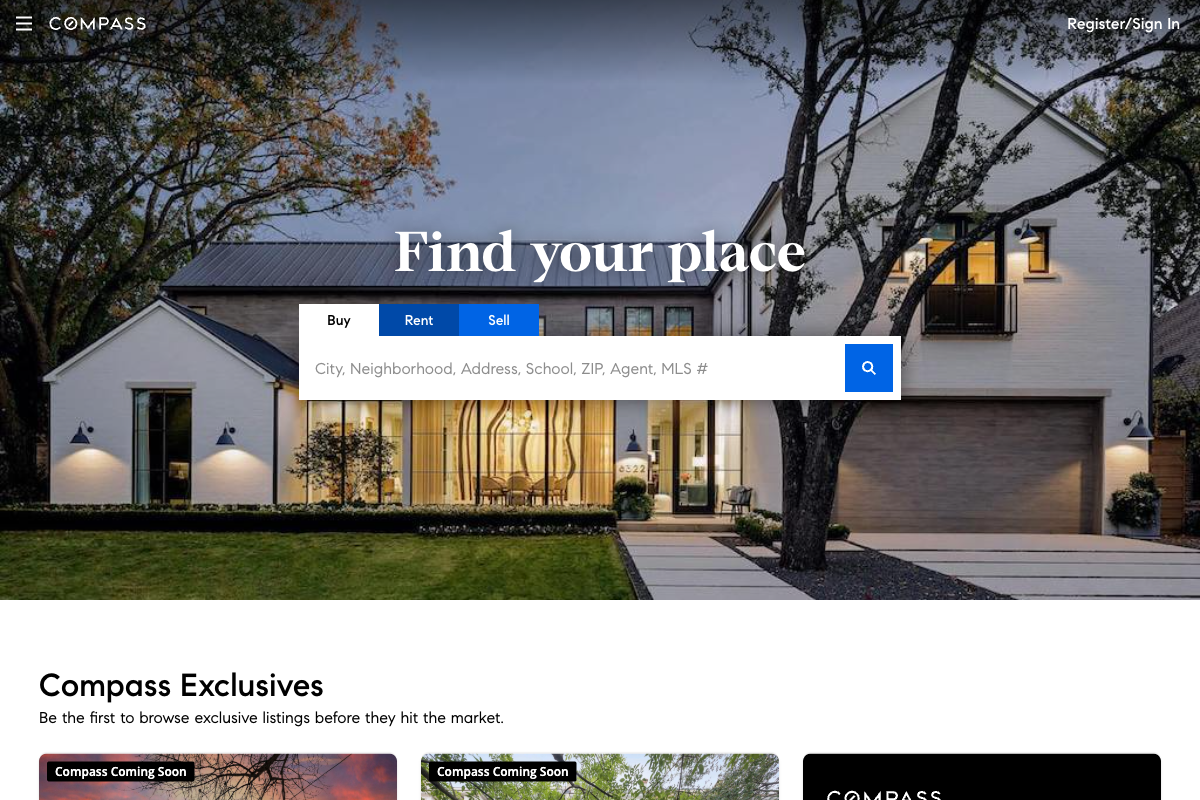
Compass: Premium brokerage model
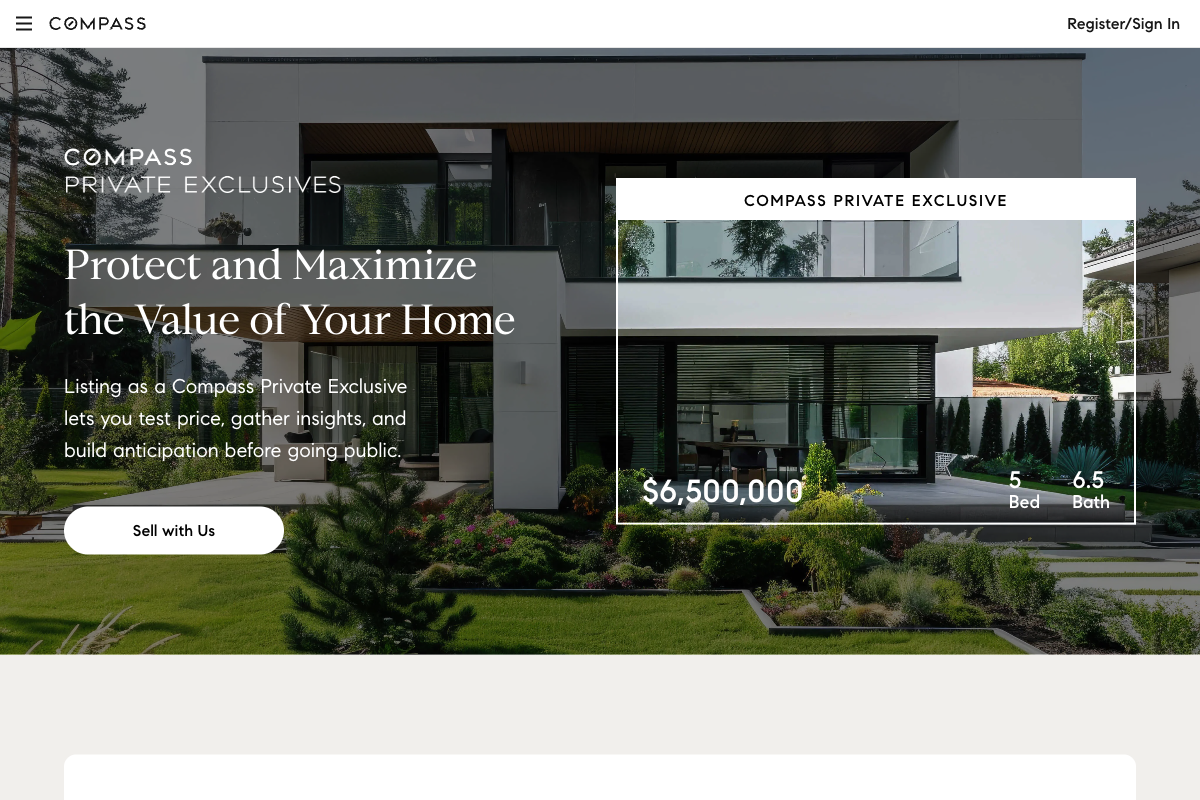
Compass - The Off-MLS Play
Compass has 35% of listings as "Private Exclusives" - off-MLS, controversial, potentially
reshaping how homes are marketed.
Leadership Transition: Eric Wu stepped down as CEO
in December 2022. Carrie Wheeler (former CFO) served as CEO from Dec 2022 - Aug 2025. In
September 2025, Kaz Nejatian (former Shopify COO) was appointed CEO, with Keith Rabois
returning as Chairman and Eric Wu rejoining the board. The founders backed the
transition with $40M in PIPE financing, signaling strong conviction in
the turnaround.
KN
Kaz Nejatian
Chief Executive Officer (Sept 2025 - Present)
Former COO at Shopify (2022-2025) where he oversaw merchant
solutions, payments, and capital products. Founded Kash (fintech, acquired 2017).
Queen's University business, University of Toronto law. Known for AI-first approach
and operational excellence. Compensation: $1 base salary, equity tied to stock price
milestones up to $33/share.
LM
Lucas Matheson
President (Dec 2025)
Former CEO of Coinbase Canada, 5 years at Shopify. Overseeing
Corporate Development, FP&A, and blockchain/tokenization initiatives for new
pathways to homeownership.
CS
Christy Schwartz
Chief Financial Officer (Jan 2026)
Promoted from interim CFO after extensive search. Former CFO at
Redfin. Deep proptech finance experience. Leading the path to sustained
profitability.
GL
Giang LeGrice
Head of Operations (Oct 2025 - Present)
Former VP of Operations at Shopify (2019-2025), where she scaled
operations through hyper-growth. 20+ years operations experience across tech,
retail, and e-commerce. Started career as an actuary. University of Manitoba (BCom,
Actuarial Math & Finance). Known as Kaz's "second-in-command" at Shopify - brought
to Opendoor to drive operational excellence and AI-powered efficiency.
CW
Carrie Wheeler
Former CEO (Dec 2022 - Aug 2025)
Served as CFO (2020-2022) before becoming CEO during company's
most challenging period. Led turnaround efforts including cost cutting and path
toward profitability. 25+ years in private equity. Stepped down in August 2025 amid
investor pressure. Currently serves on boards of TKO Group and APi Group.
EW
Eric Wu
Co-Founder, Board Member (Sept 2025 - Present)
Founded Opendoor in 2014. Stanford engineering dropout. Previously
founded Movity (acquired by Trulia). CEO 2014-2022, left company in late 2023.
Returned to board in September 2025 alongside Kaz's appointment. Also co-founder of
NavigateAI. Invested $40M alongside Khosla when Kaz was appointed.
Board of Directors
Keith Rabois - Chairman (Sept 2025). Khosla Ventures partner, PayPal
Mafia member. Original investor and co-founder. Returned as Chairman alongside Kaz's
appointment.
Other notable directors include Cipora Herman
(former Amazon exec) and Jason Kilar (former Hulu CEO, WarnerMedia
CEO).
Section 8
Current State
Latest results and the transition to Opendoor 2.0
Milestone achieved: Q2 2025 was Opendoor's first
adjusted EBITDA positive quarter since 2022 (+$23M). A significant turning point after
years of losses.
Q3 2025: The Transition Quarter
Q3 2025 reflects the deliberate inventory reset under Kaz's leadership - clearing older homes
to build fresh with AI-driven pricing:
Revenue
$915M
Beat estimates by 7%
Homes Sold
2,568
Clearing older inventory
Gross Margin
7.2%
Strong unit economics
Inventory
$1.05B
Leaner, faster turns
Q4 2025 Outlook: Acquisitions expected to increase
35%+ vs Q3 as the new AI-driven approach takes hold. Targeting breakeven Adjusted Net
Income by end of 2026.
Trump Housing Policy (Jan 2026): When Trump
announced plans to ban institutional home-buying, Opendoor stock initially dropped 10%.
CEO Kaz Nejatian clarified on X: "We're not institutional investors, our job is to help
people buy homes. We don't hold the homes!" Stock recovered after the clarification.
Recent Developments
CEO Transition (Sept 2025): Carrie Wheeler stepped down in August. Kaz
Nejatian (ex-Shopify COO) appointed CEO. Keith Rabois returns as Chairman, Eric Wu
rejoins board.
$40M Investment: Khosla Ventures and Eric Wu invested $40M alongside
new CEO appointment.
Stock Surge: Stock jumped 78% on CEO announcement news.
Opendoor 2.0: New AI-first strategy focused on software and operational
excellence.
The Turnaround Narrative
After near-death experience in 2022-2023 (90%+ stock decline, multiple layoffs), Opendoor has
stabilized. The question now: is this a launching pad for renewed growth, or a lower
plateau?
Section 9
Risks & Challenges
What could go wrong
Weathering challenges: Understanding the risks ahead
Macro Risks
Interest Rate Sensitivity
Higher rates = fewer buyers = longer holding periods = margin compression. Opendoor's
financing costs also rise with rates.
Housing Price Volatility
The core risk. A 5-10% national price decline could wipe out years of margin. The
2022-2023 experience showed this isn't theoretical.
Transaction Volume
Existing home sales remain near 30-year lows. "Golden handcuffs"
- homeowners locked into low-rate mortgages - constrain inventory.
Business Risks
Capital Intensity
iBuying requires billions in inventory. Capital costs are high, and access can tighten
quickly in downturns.
Pricing Algorithm Risk
The algorithm must be more accurate than the market. Systematic mispricing (like Zillow)
can compound quickly.
Competition
Rocket/Redfin combination. Compass off-MLS strategy. Traditional
agents still control 89%+ of transactions.
Operational Risks
Geographic Concentration: Heavy Sunbelt exposure is both opportunity
and risk
Execution Risk: New CEO, new strategy, organizational change
Regulatory: Real estate is heavily regulated; rules can change
Brand/Trust: iBuyer reputation still being established with consumers
The bear case: iBuying is structurally challenged.
Margins too thin, capital too expensive, price risk too high. Opendoor survives but
never achieves venture-scale returns.
Section 10
Opendoor 2.0
A refounding under new leadership
The vision: Buying a home as seamless as buying a car
from Tesla
The New CEO: Kaz Nejatian
In September 2025, Opendoor brought in Kaz Nejatian, former COO of Shopify,
to lead a complete transformation. His compensation? $1 annual salary -
everything else is tied to stock performance. Total skin in the game.
"We are refounding Opendoor as a software and AI company. In my first
month as CEO, we've made a decisive break from the past."
Kaz Nejatian, CEO
The Transformation
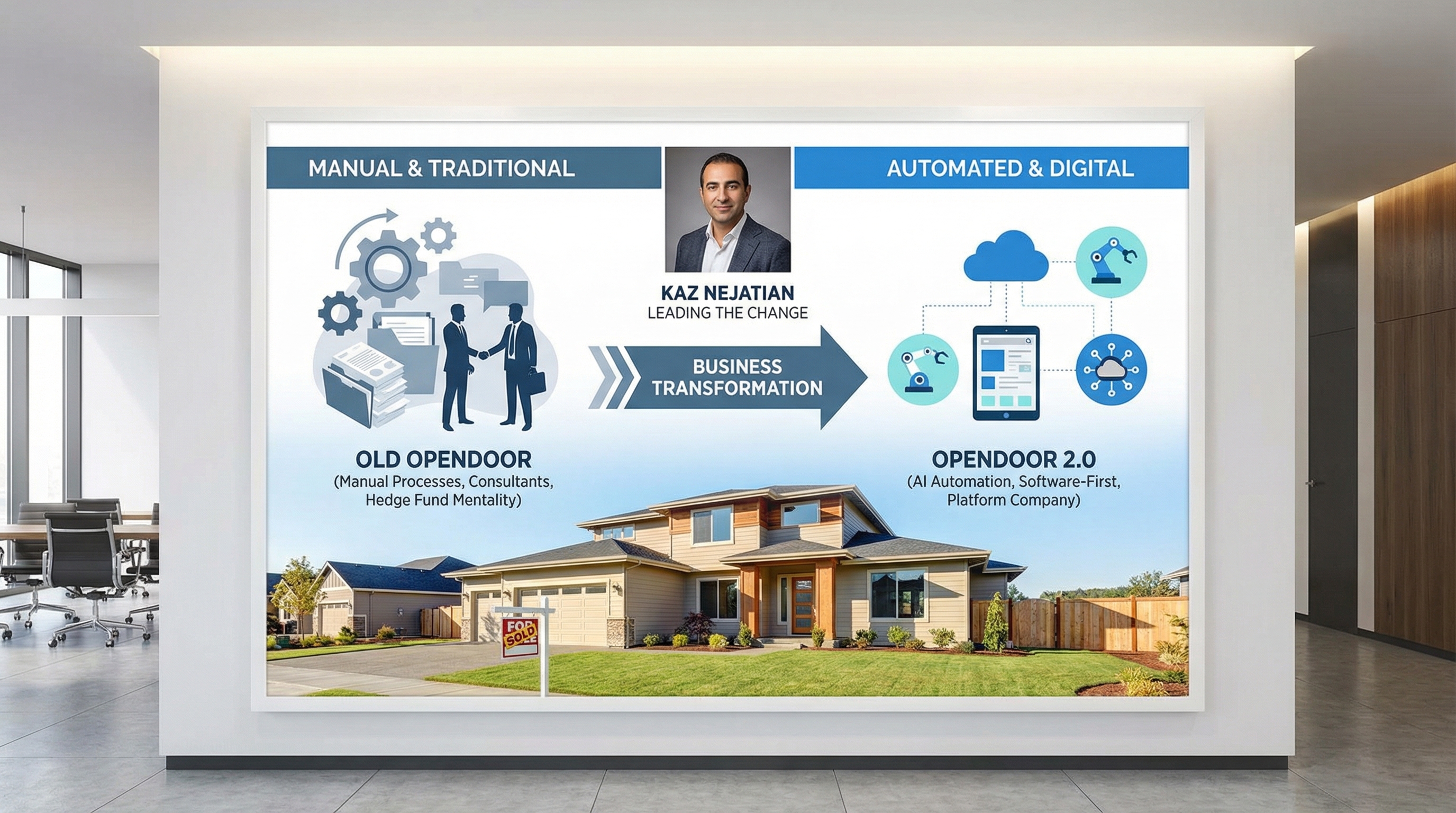
Under Kaz's leadership, Opendoor is being completely rebuilt - from an iBuyer with technology
to a technology company that buys homes:
The refounding: From hedge fund mentality to AI-native
platform
The Philosophy Shift
From hedge fund to tech company: "Our job is not to run a hedge fund
that aims to make money off of macroeconomics. Our job is to buy and sell lots and lots
of homes at very tight spreads and make money off of transaction volume."
The mission: "If we can make buying, selling, and owning a home easier
and less terrible, the world will be a better place. If we do that, we'll make money
along the way."
The urgency: "The fact that the average age of a
person who buys their first home now is 40 is deeply depressing. That has such negative
implications for our society."
The "Default to AI" Mandate
Within his first weeks, Kaz sent a company-wide memo requiring employees to "default to AI"
in their work. The specific mandates:
Kaz's Day-One Changes
Return to office: Mandatory in-person work to increase velocity
No more consultants: "Decisions that executives should be making"
were being outsourced
AI-first operations: Staff were manually copying PDF data into
spreadsheets - that stops
Founder mode: "We are ditching manager mode. We're firmly in
founder mode now."
Weekly accountability: Progress tracked at accountable.opendoor.com
The Elon Musk Playbook: Kaz is running the classic
"new CEO turnaround" - $1 salary (up to $2.8B in equity tied to stock milestones),
relentless X updates on progress, cutting consultants, and demanding founder-level
intensity from the entire organization.
Immediate Results
Acquisition Speed
2.3x
120 → 282 homes/week by Nov 2025
New Products Launched
12+
AI-powered features in first month
"Opendoor's procurement team is so AI-pilled that they are now using
AI tools to cancel useless SaaS contracts across the board. In one area, we will soon go
from paying 10 (ten!) different providers to paying just one + our internal AI tool,
saving us million $+ a year."
Kaz Nejatian, on X (December 2025)
"First pic took 10 years of work without AI. Second pic took
10 weeks of work with AI."
Kaz Nejatian, on X (January 2026) — on Opendoor's expansion
The Vision: Everything a Homeowner Needs
"Buying a home will in the future be as seamless as buying a car from
Tesla. Right now, homeowners have to deal with a bunch of different companies, brokers,
agents. We're going to fix this - and over time, we'll add everything a homeowner needs
when they need it, all bundled into one simple experience."
Kaz Nejatian
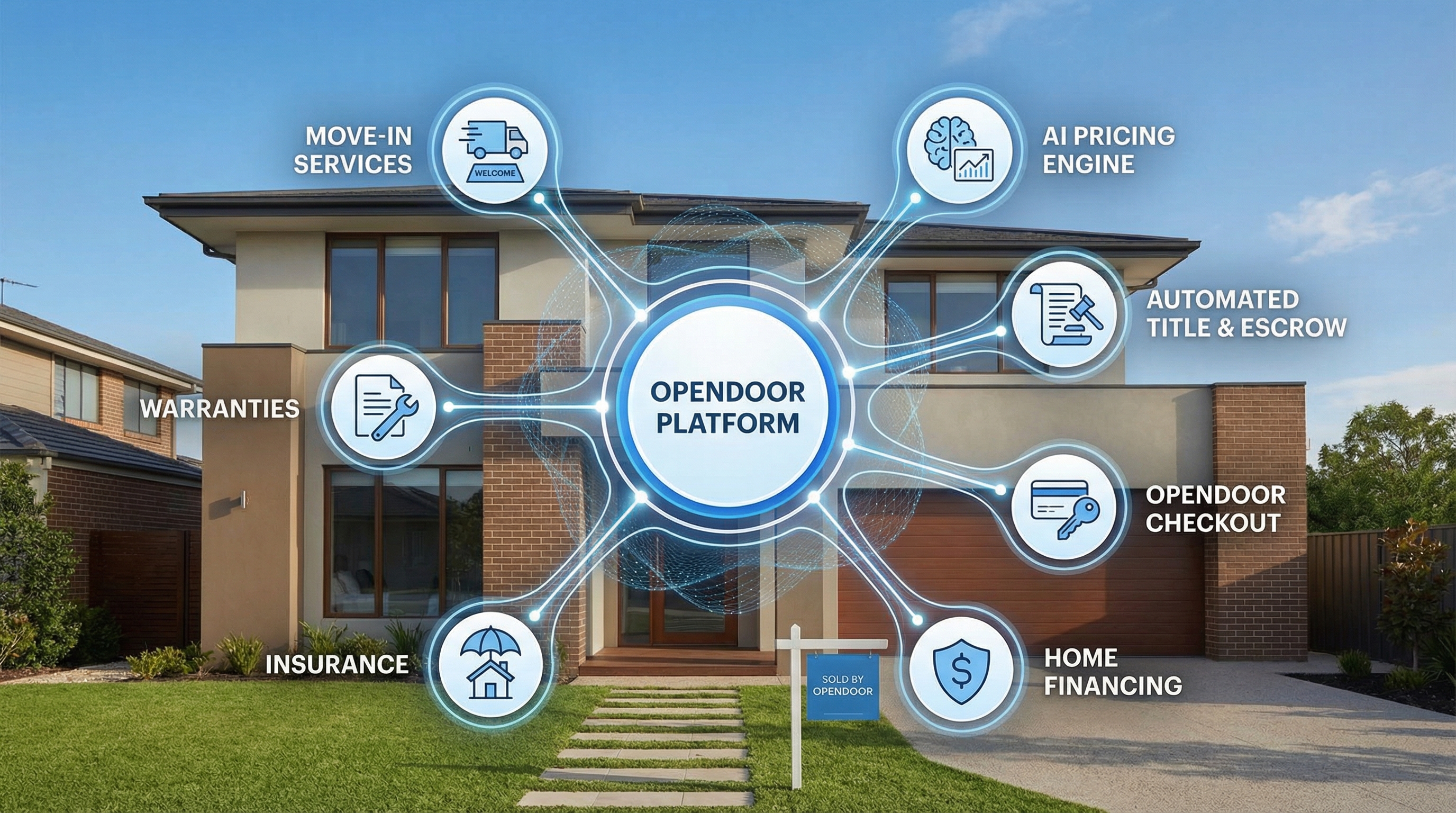
The AI-Native Platform
Kaz's vision is to build a single platform that handles everything a homeowner needs -
powered by AI at every step:
One platform, every service: The Opendoor ecosystem
New Product Initiatives
Opendoor Checkout
"The buy now button for homes on the internet" - tour and
submit offers directly, no agent needed
Try Before You Buy
Move in, live in the home, return it if you don't love it
(launched in Dallas)
AI Automation
Eliminating manual work - no more copying PDFs into
spreadsheets
Asset Tokenization
"I can't imagine a future where real estate is not tokenized"
- exploring blockchain pathways to ownership
Path to Profitability
The goal: "By the end of next year, we will drive
Opendoor to breakeven Adjusted Net Income on a 12-month go-forward basis." The path:
more sellers, better pricing, faster resales, ruthless efficiency.
What to Watch
Contribution Margin
Can they sustain 5%+ consistently?
Acquisition Velocity
Maintaining the doubled pace?
Product Adoption
Checkout, Try-Before-Buy traction
Cash Flow
Operating cash flow positive?
The Bottom Line
Opendoor has survived what Zillow couldn't. Under Kaz's leadership, the company is being
refounded - not as a real estate speculation play, but as a technology company that happens
to operate in real estate. The question isn't whether the vision is right. It's whether they
can execute fast enough.
The bet: If Opendoor can capture even 3-5% of the
$2T residential market with sustainable margins, it becomes a $50B+ company. Kaz
believes it can become a "multi-hundred billion dollar company." That's the opportunity.
Section 11
Financial Overview
Key metrics and financial health indicators
Financial Summary
The situation: Opendoor lost $2.7 billion from 2021-2024 and stock fell 98.7%. New CEO Kaz Nejatian took over September 2025. Stock has recovered +294% since the April low.
The financials: $962M cash on hand, 15+ quarters of runway, contribution margin at 2.2% (down from 4.7% in Q1). Targeting breakeven by end of 2026.
What to watch: Q4 2025 earnings on February 26, 2026. Contribution margin on new inventory is the key indicator.
Q3 2025 Financial Snapshot
The most recent quarter reflects Kaz's "clearing the decks" strategy — selling old inventory at compressed margins while ramping up AI-driven acquisitions.
Revenue
$915M
Beat guidance by 5%
Adj. EBITDA
$(33)M
Below guidance range
Net Income
$(90)M
vs $(78)M Q3 2024
Contribution Margin
2.2%
Down from 4.7% Q1
Homes Sold
2,568
Clearing old inventory
Homes Purchased
1,169
AI-priced acquisitions
Kaz's View: "We are refounding Opendoor as a software and AI company. Our business will succeed by building technology that makes selling, buying, and owning a home easier — not from charging high spreads and hoping the macro saves us."
The 10 Metrics That Matter
These are the numbers Kaz and investors are watching most closely. Each tells a different part of the turnaround story.
1. Revenue (Quarterly)
$915MQ3 2025
Revenue beat guidance ($875M high-end) by 5%, but declined 33% year-over-year as Opendoor deliberately reduced inventory.
Why Kaz cares: Revenue will drop ~35% in Q4 as old inventory clears. The bet is that AI-priced homes acquired now will generate healthier revenue in 2026.
2. Adjusted EBITDA
$(33)MQ3 2025
Missed guidance of $(21-28)M loss. EBITDA excludes interest, taxes, depreciation, and one-time charges — showing core operational profitability.
Why Kaz cares: Q4 guidance is $(45-55)M loss as margins compress further. Kaz is targeting Adjusted Net Income breakeven by end of 2026.
3. Contribution Margin
2.2%Q3 2025
The profit margin on each home after direct costs (acquisition, repairs, holding, selling). Dropped from 4.7% in Q1 as old inventory sold at losses.
Why Kaz cares: This is THE metric. Kaz says the old Opendoor relied on "wide spreads" (high margins). The new strategy: high velocity with tighter but consistent margins. If new AI-priced inventory achieves 4%+, the model works.
4. Net Income (Loss)
$(90)MQ3 2025
GAAP net loss increased from $(78)M in Q3 2024. This includes all expenses — the true bottom line showing Opendoor is still burning cash.
Why Kaz cares: Accumulated losses since 2021 total ~$2.7B. Kaz's credibility depends on bending this curve toward zero by late 2026.
5. Cash & Liquidity
$962M
Unrestricted Cash
$490M
Restricted Cash
$1.45B
Total Cash
Strong balance sheet with more cash than long-term debt ($439M). Restricted cash is tied to inventory financing and can't be used freely.
Why Kaz cares: At ~$60M quarterly burn, Opendoor has 15+ quarters of runway. This gives Kaz time to execute without dilutive capital raises.
6. Homes Sold (TTM)
~11,000Trailing 12 months
Q3 2025 saw 2,568 homes sold (down 29% YoY). Volume is intentionally low as Opendoor clears legacy inventory and rebuilds with AI-priced homes.
Why Kaz cares: Volume drives revenue and data. Kaz's stated goal: 6,000 homes/quarter by Q4 2026 — a 5x increase from current levels.
7. Inventory Aging (>120 days)
ElevatedLegacy inventory
Homes older than 120 days incur significant holding costs and typically sell at losses. Q2 showed a high portion of aged inventory — a key reason Q3 margins dropped.
Why Kaz cares: "Clearing the decks" means selling this old inventory at compressed margins. Once cleared, new AI-priced inventory should have lower aging and better margins.
8. AI Products Deployed
12+Products launched
In Kaz's first month, Opendoor launched 12+ AI products: automated home assessments (10 min vs 1 day), repair scoping, title/escrow automation, and pricing models.
Why Kaz cares: "We are refounding Opendoor as a software and AI company." AI reduced assessment time 95% and nearly doubled acquisition velocity (120→230 homes/week in 7 weeks).
9. Operating Cash Flow
$979MYTD 2025
Strong operating cash flow YTD, largely because inventory declined by ~$1.1B. Cash generated from selling homes faster than buying them.
Why Kaz cares: This isn't "real" operating improvement — it's from shrinking the business. True operational cash flow improvement will come from profitable unit economics on new inventory.
10. Market Cap & Stock Volatility
$6.4B
Market Cap
3.69
Beta (volatility)
$0.51-$10.87
52-Week Range
Stock is up +341% over 12 months but extremely volatile (beta 3.69 = 3.7x market movements). 52-week range shows a 21x swing from low to high.
Why Kaz cares: Kaz took $0 salary and ~$1B in equity compensation. His wealth is directly tied to stock performance. Every earnings call is high-stakes.
Understanding Contribution Margin
Contribution margin measures profit per home after direct costs. It's the most important metric for evaluating Opendoor's unit economics.
How it works: Buy a home for $300K → Fix it for $15K → Pay $5K in holding costs → Pay $8K in selling costs → Sell for $340K. Result: ($340K - $300K - $15K - $5K - $8K) / $340K = 3.5% margin
At 2.2%, Opendoor keeps $2.20 for every $100 in revenue. That's tight margins with little room for error.
Contribution Margin Trend
Quarter
Margin
Notes
Q1 2025
4.7%
Healthy margin
Q2 2025
4.4%
Slight decline
Q3 2025
2.2%
Clearing old inventory
Q4 2025
TBD
Results: Feb 26, 2026
Why Q3 margin dropped: Opendoor deliberately cleared older, overpriced inventory from the previous management era. Management expects margins to recover as newly-priced homes flow through.
Balance Sheet Strength
Despite ongoing losses, Opendoor has a strong balance sheet with more cash than debt.
Unrestricted Cash
$962M
Total Cash (incl. restricted)
$1.45B
Long-term Debt
$439M
Negative net debt: Opendoor has more cash ($962M) than long-term debt ($439M). At $61M quarterly losses, they have 15+ quarters (~4 years) of runway before needing additional capital.
Stock Price History
Date
Price
Context
Feb 2021
$39.24
All-time high (SPAC peak)
Nov 2021
$24.00
Zillow exits iBuying
Dec 2022
$3.00
Rate shock, $1.4B annual loss
Apr 2025
$0.51
All-time low (delisting threat)
Sep 2025
$9.26
Kaz equity raise
Jan 2026
$6.70
Current (+294% from April low)
Scenario Analysis
Bull Case
25% probability
$15-25
Margin recovers to 4%+, velocity 4x, AI creates competitive moat
Wall Street is divided on Opendoor. Here's what different sources report as of January 2026.
Analyst Consensus
SELL / HOLD
1 Buy · 5 Hold · 3 Sell
Avg Price Target
$1.60 - $3.56
Range: $0.91 to $8.40
AI Analysis (Danelfin)
7/10 BUY
57% chance to outperform
Price target disconnect: Current stock price (~$6.70) is ABOVE most analyst targets. Many analysts see 54-76% downside, while the stock has already rallied 1,000%+ from lows. Analysts may be slow to update targets, or the stock may be overvalued.
Bull vs Bear Case
The Bull Case
AI transformation could genuinely fix unit economics
If 5-7% contribution margin achieved, stock re-rates higher
New leadership making hard decisions (clearing bad inventory)
The metric to watch: Contribution margin on newly-acquired inventory. If it recovers to 4%+ on homes purchased under Kaz's pricing models, the turnaround thesis is validated. If it stays below 2.5%, the path to profitability becomes much harder.